New ESurf Letter: From regular to random: a unifying framework for step-pool spacing
26 August 2026
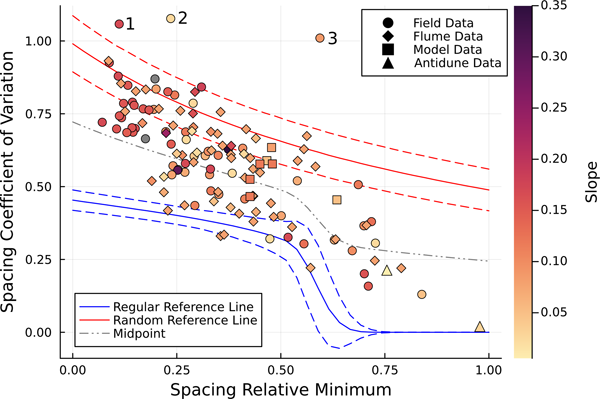
The expected spacing of step-pool sequences has long been mired in debate, hampering stream restoration efforts. The authors define a continuum to evaluate the degree of regularity and randomness across step-pools from field observations, flume experiments, and numerical simulations and show that the full range is occupied without one formation mechanism dominating. Bounds related to channel hydraulics provide a way to track dynamic step spacing without assuming a mechanism.
Editorial statement: Mountain streams comprise between 60 and 80% of total global river length. A primary trait of these streams are step-pool sequences. Whether the spacing of these features are regularly or randomly spaced is matter of debate. Erikson and Turowski resolve longstanding tension between the two competing models. Using data on natural, experimental, and numerically simulated step-pool sequences, they demonstrate that step-pool spacing rarely matches either assumption, but rather exists within a continuum. The findings of Erikson and Turowski challenge existing step-pool formation models, emphasize that efforts to replicate or install step-pools are fundamentally misguided when assuming regularity or randomness, and offer a potential alternative.
Contact: Christian M. Erikson (erikson@gfz.de)